

Book a 1-hour Berlin boat tour on the River Spree with a bilingual live guide, panoramic boat and views of the Reichstag, Museum Island and the German Chancellery.
View experienceHow to Get Around Berlin: The Best Way for a First Visit
For most travelers, the most sensible combination is public transport plus walking through specific neighborhoods. Berlin is not a city to cross entirely on foot, but it is a wonderful city to explore by area: Unter den Linden and Museum Island, Kreuzberg along the canal, Prenzlauer Berg at sunset, Friedrichshain around Boxhagener Platz, or Charlottenburg if you are looking for a more elegant, classical Berlin.
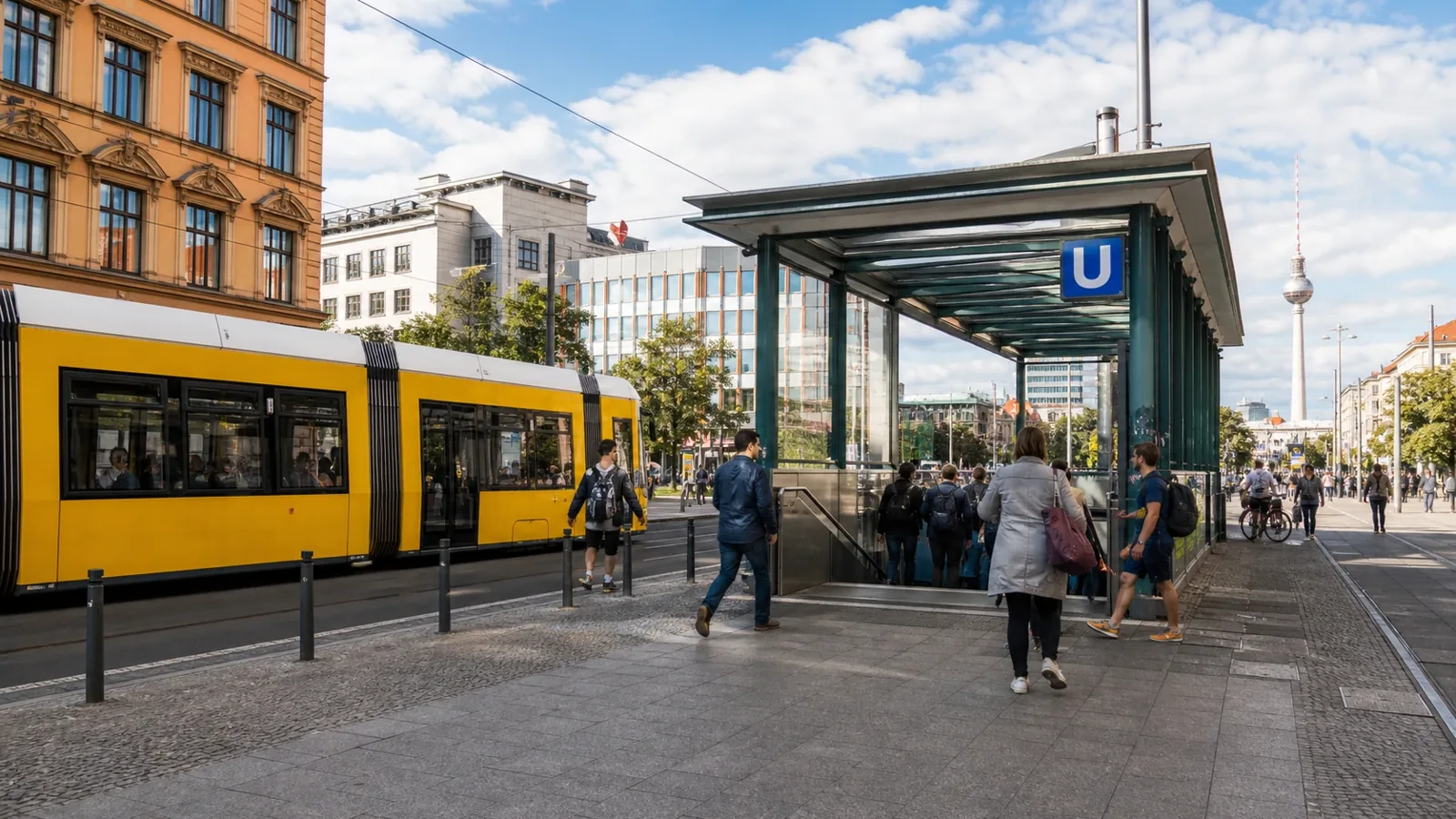
Berlin public transport covers the city very well. The network includes the U-Bahn underground, S-Bahn urban rail, trams, buses, and regional trains; tickets are organized by zones, with AB being the usual choice for getting around the center and main neighborhoods, while ABC is needed for journeys such as BER Airport or Potsdam. According to official information from BVG and VBB, in 2026 a single AB ticket starts at €4.00, the short-trip ticket at €2.80, and the journey between the center and BER Airport requires an ABC ticket.
To travel to or from BER Airport, remember: you need an ABC ticket, not AB.
U-Bahn, S-Bahn, Tram, and Bus: What to Use in Each Case
U-Bahn: fast for moving around the inner city. The Berlin U-Bahn is practical, frequent, and very useful for moving between central neighborhoods. It is the option you will probably use most if you are staying in Mitte, Kreuzberg, Schöneberg, Charlottenburg, or Neukölln. Its stations are not always beautiful, and some have that functional, slightly rough feel of everyday Berlin, but they do their job very well.
Always check the train’s final destination before getting on. Berlin is not very forgiving of distraction: one wrong stop can turn into a long detour.
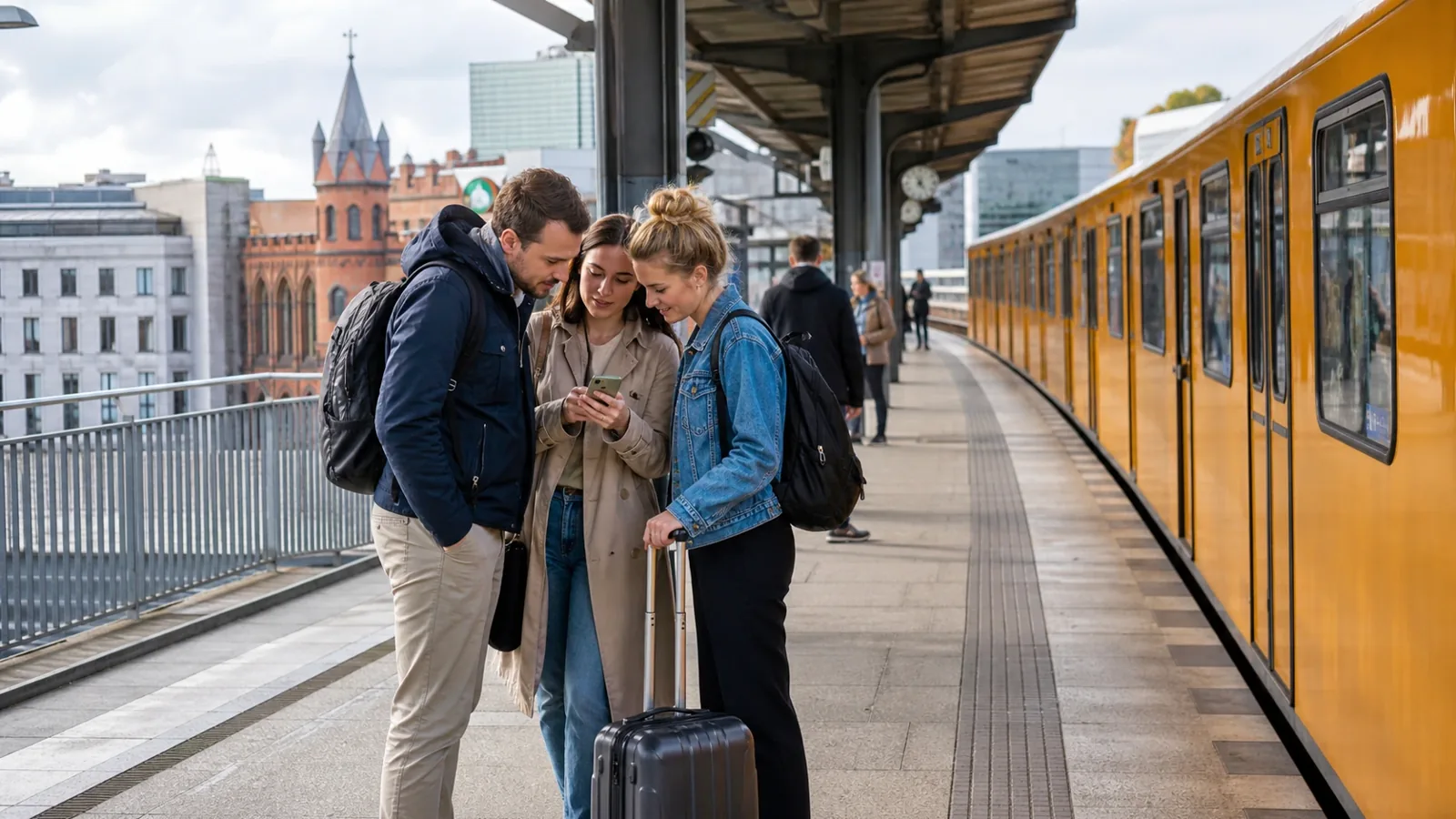
S-Bahn: ideal for longer distances and key connections. The Berlin S-Bahn is perfect for crossing the city, reaching more distant areas, or moving around the famous Ringbahn. It is also very useful for connections with major stations such as Hauptbahnhof, Ostkreuz, Südkreuz, or Zoologischer Garten.
It has one clear advantage: it helps you understand Berlin’s real scale. From the window, the city appears as a succession of inner courtyards, elevated tracks, industrial façades, trees, graffiti, and gray rooftops. It is not always the prettiest postcard view, but it is one of the most honest.
Tram: the practical charm of the East. The Berlin tram is especially useful in former East Berlin: Prenzlauer Berg, eastern Mitte, Friedrichshain, Lichtenberg, and Pankow. It is comfortable, pleasant, and lets you see the city from street level. For travelers who are not in a hurry, the tram has something of an urban stroll about it: it glides past cafés, parks, broad intersections, and residential blocks with a calm the underground cannot offer.
Bus: useful, but less predictable. The bus can be convenient on specific routes, especially where the underground or trains do not provide good coverage. Some lines pass through very interesting areas, but traffic and roadworks can make the journey slower. I would not choose it as the first option when in a hurry, although it can be pleasant for short trips or for seeing the city without going underground.
Always check the train’s final destination before getting on.
How to Get from BER Airport to the Center
Berlin Brandenburg Airport is connected to the city by regional trains, the Airport Express, and S-Bahn. The Airport Express FEX connects the airport with places such as Hauptbahnhof, Potsdamer Platz, and Südkreuz; DB Regio states that the journey from the center can take up to around 23 minutes and that trains run every 15 minutes.
There are also S-Bahn connections, such as lines S9 and S45 from Terminal 1-2, although they are usually slower. BVG notes that the FEX departs from BER Terminal 1-2 and connects with stations such as Ostkreuz, Gesundbrunnen, and Hauptbahnhof, while the S-Bahn lines offer regular departures into the city.
To travel to or from the airport, remember: you need an ABC ticket, not AB. This is one of the most common mistakes travelers make when using Berlin public transport.
To travel to or from the airport, you need an ABC ticket, not AB.
Is It Worth Renting a Car in Berlin?
In general, no. For visiting Berlin, a car is usually more of a nuisance than an advantage. Parking can be inconvenient, traffic is not always pleasant, many areas are best enjoyed on foot, and public transport covers almost all tourist journeys.
Renting a car would only make sense if you plan to take trips outside the city, visit villages or natural areas with poor transport connections, or include Berlin as part of a wider journey through Brandenburg. For an urban break of two, three, or four days, a car can become an unnecessary expense.
Getting Around by Bike: A Good Idea, but Not for Everyone
Berlin is a very bike-friendly city and cycling can be a lovely way to explore it, especially in spring, summer, and early autumn. Wide avenues, parks, canals, and some residential neighborhoods are very well suited to cycling. There are also rental services and shared bikes throughout the city.
But do not idealize the experience. Distances are long, some streets have heavy traffic, bike lanes are not always equally comfortable, and winter can be cold, damp, and unforgiving. For travelers used to cycling in cities, getting around Berlin by bike can be fantastic. For anyone who does not feel confident among cars, trams, and large intersections, it is better to use a bike only in quieter areas.
Cycling can be fantastic if you are used to riding in cities, but do not idealize the experience.
Walking in Berlin: Yes, but Strategically
Walking in Berlin is one of the great pleasures of the trip, as long as you do not try to cover too much. The city is best enjoyed in fragments. A good day might combine public transport to reach a neighborhood with several hours of walking around it without a rigid plan.
Mitte is convenient for a first impression: the Brandenburg Gate, Reichstag, Museum Island, and Alexanderplatz can be linked together with breaks. Kreuzberg calls for a different rhythm: cafés, the canal, courtyards, bars, markets, and urban memory. Prenzlauer Berg is gentler, with tree-lined streets and a domestic beauty that is best appreciated without rushing.
The mistake is trying to walk from everywhere to everywhere. Berlin is not Paris or Florence. Here, distances stretch out, avenues open wide, urban voids appear suddenly, and fatigue arrives sooner than expected.
Berlin is best enjoyed by area, not by trying to walk from everywhere to everywhere.
Night Transport and Safety When Getting Around
Berlin has real nightlife, not decorative nightlife. Many areas remain active late into the night, especially Kreuzberg, Friedrichshain, Neukölln, and Mitte. Night transport does exist, although it may require more patience, transfers, or waiting. At night, it is worth checking your route before heading out, especially if you will be returning from clubs or bars in more remote areas.
In general, getting around Berlin is safe, but some stations can feel rather rough in the early hours. Not necessarily dangerous, but not especially pleasant either: poor lighting, drunk people, deserted platforms, or tense atmospheres. Basic common sense works well: keep an eye on your belongings, avoid arguments, do not fall asleep on long journeys, and check the last connection before getting too confident.
At night, check your route before heading out and verify the last connection.
Common Mistakes When Getting Around Berlin
The first is not validating your ticket. In Berlin, there are not always visible barriers as in other European metros, but that does not mean you can travel without validating. Ticket inspections do happen, and fines rarely leave much room for tourist excuses.
The second is buying an AB ticket when you need ABC, especially for going to the airport or to Potsdam.
The third is underestimating distances. Two places may look close on the map and require much more time than expected.
The fourth is relying only on taxis or ride-hailing apps. They work, but they do not always make sense in terms of price or time compared with public transport.
The fifth is staying far out without checking connections. A cheaper hotel can cost you dearly in lost minutes if it is poorly connected by U-Bahn or S-Bahn.
Not validating your ticket and buying AB when you need ABC are two of the most common mistakes.
So, What Is the Smartest Way to Get Around?
For a first visit, the most balanced approach is to stay near a well-connected station, buy tickets according to the rhythm of your trip, and organize each day by area. Use public transport for the big jumps and save your steps for what Berlin does best: revealing its character slowly, on a graffiti-covered corner, in a neighborhood bakery, on a bridge over the Spree, on an elevated platform at sunset.
Berlin is not always comfortable, nor always beautiful in the classical sense. But getting around it is part of understanding it. It is a city of journeys, layers, and contrasts. A city where the trip does not happen only when you arrive at a monument, but also between one station and the next.