

Book your The Upside Down Experience Berlin ticket for 25+ immersive rooms, optical illusions, creative photos, and digital photo downloads.
View experienceWhy Berlin is worth visiting
Berlin cannot be understood simply by looking at monuments. It is understood by walking. At the Brandenburg Gate, the solemnity of history is concentrated in one place; on Museum Island, the cultural weight of Europe; in Kreuzberg and Neukölln, the everyday, mixed and nocturnal city; in the Tiergarten, a green pause amid broad avenues and political memory.
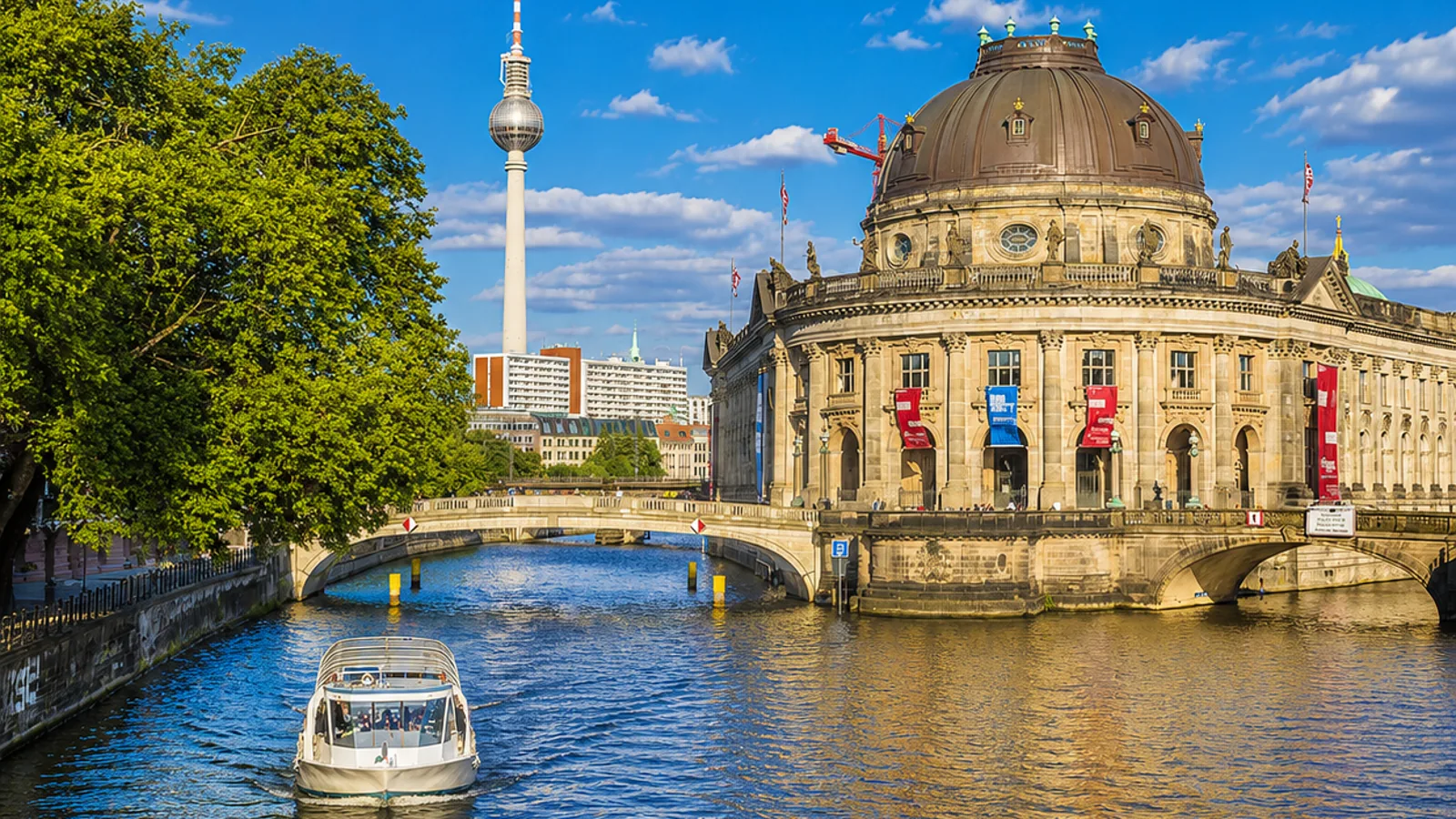
Museum Island brings together five major museums on the Spreeinsel and is part of the UNESCO World Heritage Site, one of the great cultural reasons to travel to Berlin if you care about art, archaeology and European history.
But reducing the city to its museums would be unfair. Berlin is also in its inner courtyards, in its dimly lit bars, in Sunday flea markets, in Soviet-era blocks and in cafés where no one seems in any hurry to leave.
What kind of traveller Berlin is worth it for
Berlin is a great choice for curious travellers, lovers of contemporary history, art, architecture, electronic music, museums and cities with a character of their own. It also works very well for those who enjoy exploring neighbourhoods without needing everything to be monumental.
It is especially worthwhile if you are interested in the Second World War, the Cold War, the Wall, European memory and alternative urban life. Few cities explain the 20th century so well without turning everything into scenery.
On the other hand, it may not be your best choice if you are looking for a polished romantic break, a small city to wander through without much thought, pleasant weather all year round or a uniform kind of beauty. Berlin can feel grey, spread out, somewhat harsh in winter and less charming than Prague, Vienna or Paris.
How many days to spend in Berlin
One day in Berlin is enough to see a small selection of the centre, but not to understand the city. The tourist office itself acknowledges that 24 hours is not enough to explore its neighbourhoods, monuments and historical layers.
Ideally, you should allow 3 or 4 days. With that amount of time, you can combine the Brandenburg Gate, the Reichstag, the Holocaust Memorial, Museum Island, the East Side Gallery, Kreuzberg, Prenzlauer Berg and a market or park.
With 2 days, Berlin can still be enjoyed, but you will have to choose carefully. With 5 or more, it begins to show its best side: that of a city that does not reveal itself to hurried tourists, but to those who stay long enough to get a little lost.
Ideally, you should allow 3 or 4 days; with 5 or more, Berlin begins to show its best side.
Is Berlin expensive?
Berlin is no longer the cheap capital it was years ago, although it remains more flexible than other major European cities. Accommodation can become quite expensive during trade fairs, summer, concerts and weekends. Eating out can be reasonable if you alternate simple restaurants, bakeries, markets and international food, but the city also has an increasingly sophisticated dining scene.
Public transport is a major advantage: the U-Bahn, S-Bahn, tram and bus network makes it easy to get around without a car. As a current reference, the single AB ticket starts at €4 and the 24-hour AB ticket at €11.20, although it is worth checking fares before travelling because they can change.
A mid-range budget can remain reasonable if you book accommodation in advance, choose the right area and do not centre the entire trip around expensive restaurants or paid museums.
It is worth checking fares before travelling because they can change.
The best of Berlin
The best thing about Berlin is its depth. It is not a city you simply look at: you read it. Every square seems to have a second layer. Every new building seems to be in dialogue with an absence. There is beauty, yes, but it often appears mixed with concrete, graffiti, elevated stations, urban scars and a cold light that can be beautiful at sunset.
Its freedom also stands out. Berlin allows for many different rhythms: the museum traveller, the night owl, the food lover, the family visitor, the history enthusiast, the creative traveller. Few European capitals accommodate such different styles of travel so well.
What can disappoint in Berlin
Berlin can disappoint anyone expecting a monumental, orderly city on every corner. Distances are long, some areas can seem neglected, the weather can be severe and certain very famous places are more symbolic than visually striking.
The Brandenburg Gate is moving because of what it represents, not because it is a long visit. Checkpoint Charlie can feel too touristy. The East Side Gallery has historical and visual power, but it is also often crowded and surrounded by a modern city that does not always encourage contemplation.
Best time to visit Berlin
The experience changes a lot depending on the season. Spring and early autumn usually offer the most pleasant balance: better light, manageable temperatures and a lively city without the weight of winter. Summer brings long days, terraces, parks and an outdoor atmosphere, but also more visitors and higher prices. Winter can be harsh: cold, low skies, short days. Even so, it has a sober beauty for those seeking museums, cafés, Christmas markets and a more introspective Berlin.
So, is Berlin worth visiting?
Berlin is very much worth it if you accept that its beauty is not always comfortable. It is not a city for collecting pretty photos without effort, but for walking, thinking, going out at night, entering museums, reading plaques, crossing bridges, hearing different languages and understanding that Europe is also made of ruptures.
It is better for curious travellers than impatient tourists. Better for those who value history than those looking only for charm. Better for anyone who enjoys a living, imperfect and contradictory city.
Berlin does not try to please everyone. And perhaps that is why, when it connects with you, it does so in a way that is hard to forget.