

Book a private day trip to Marrakech from Agadir, Taghazout or Tamraght with a local driver, hotel pickup, private vehicle and flexible itinerary.
View experienceHow to get around Marrakech medina: walking
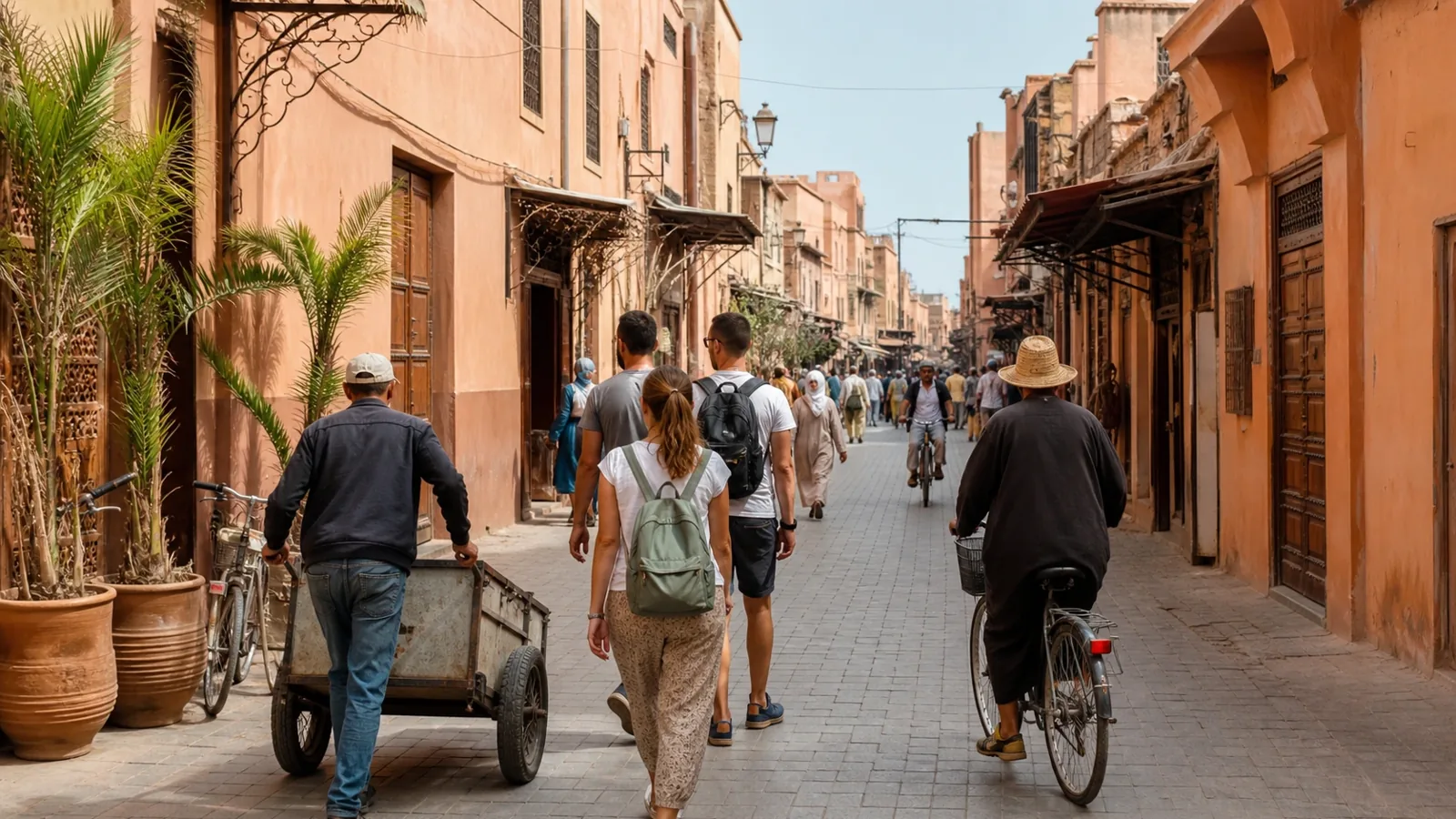
Inside the medina, walking is usually the most sensible option. Many alleyways are too narrow for cars, and although motorbikes and bicycles do pass through, visitors soon discover that their feet are the real transport of Marrakech.
Jemaa el-Fna square, the Koutoubia, the souks, madrasas, palaces, and many riads are all within reasonable distance of one another. The problem is not always distance, but orientation. The medina is not made for walking in a straight line: one street bends, another narrows, a doorway seems to appear out of nowhere, and suddenly the map loses its authority.
It is worth staying in a well-located area if you want to explore Marrakech on foot. Sleeping near Jemaa el-Fna makes the first visits much easier, although it can be noisy. Mouassine, Riad Zitoun, Kasbah, or the areas around Bab Doukkala can offer an interesting balance, depending on the type of traveler.
What may disappoint some visitors is the intensity: persistent vendors, motorbikes passing very close by, dark streets at night, and an initial sense of disorder. This is not a medina for walking around distractedly with your phone in your hand. It is better to move with attention, without fear, but with your senses awake.
The medina is best experienced on foot, but it is better to walk attentively and not trust the map blindly.
Taxis in Marrakech: useful, but negotiate calmly
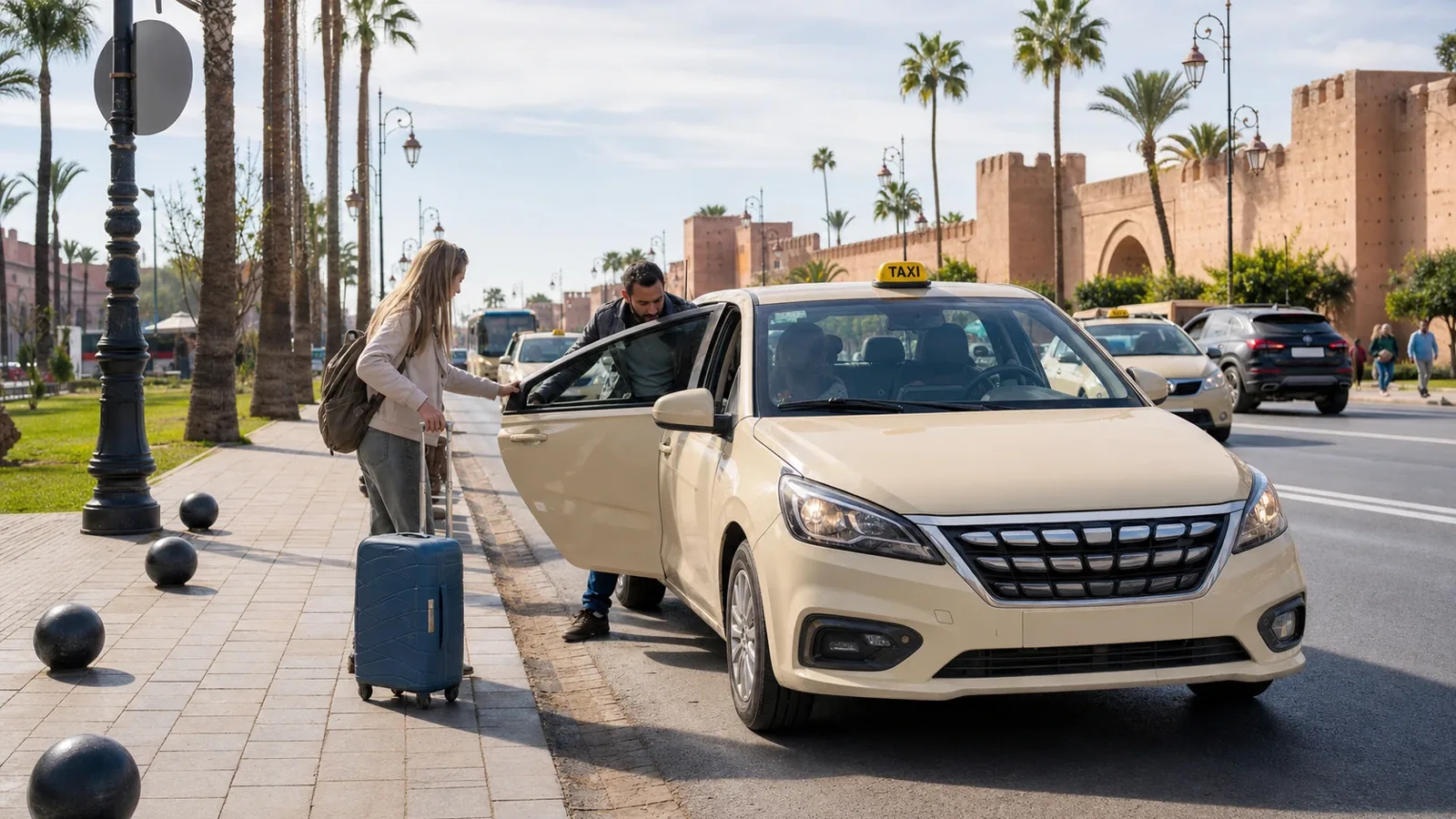
Petit taxis are one of the most practical ways to move between the medina, Guéliz, Hivernage, the train station, Majorelle, or restaurants that are farther away. They are small, plentiful, and inexpensive compared with many European cities, although the experience depends heavily on the driver, the traffic, and the negotiation.
Ideally, you should ask them to use the meter. In practice, especially near tourist areas, some drivers will prefer to agree on a fixed price. There is no need to get into an argument; simply ask before getting in, compare with another taxi if the price seems excessive, and keep a calm attitude. Marrakech rewards polite firmness more than anger.
At night, from restaurants or less busy areas, a taxi may be the most comfortable option. The same applies if you are traveling with children, luggage, or in intense heat. Even so, at rush hour the avenues can become clogged, and a short journey may take longer than expected.
Ask the price before getting in if the meter is not used, and compare with another taxi if the fare seems excessive.
City buses and public transport in Marrakech
Marrakech has an urban bus network operated by ALSA, which also runs services in several Moroccan cities, and there is also an official double-decker tourist bus covering key points in the city. For travelers on a tight budget, the city bus can be useful, but it is not always the simplest option: stops, timetables, and connections can feel less intuitive than taking a taxi or walking.
The tourist bus may appeal to those traveling with limited time, older visitors, families, or anyone who prefers a panoramic overview without negotiating taxis. It does not replace the experience of getting lost in the medina, but it can be a pleasant way to connect more open areas, gardens, and avenues.
For those who want to experience Marrakech in a more local way, the city bus makes sense. For those with only two or three days, walking and taking the occasional taxi will usually be more efficient.
From Marrakech airport to the center: arrange it beforehand
Marrakech-Menara Airport is relatively close to the city, but arrival can be confusing if it is your first time. With luggage, heat, and tiredness, it is worth knowing how you will reach your accommodation before you land.
Many riads offer private transfers, and this can be worthwhile if you arrive at night or if your accommodation is tucked away on a hard-to-find street. In the medina, the car may not reach the door: sometimes you will need to walk a few minutes with your luggage or be guided by someone from the accommodation.
There are also taxis and transport services at the airport, but the important thing is to confirm the price before setting off. If you want to save money, check the bus options available at the time of your trip, as routes and conditions can vary.
If you arrive at night or stay in a hard-to-find riad, a private transfer can make the first arrival easier.
Guéliz, Hivernage, and the new city: better by taxi or walking in sections
Marrakech’s new city has a different rhythm. Guéliz and Hivernage are wider, straighter, with modern cafés, shops, galleries, large hotels, and avenues where the city’s earthy red blends with storefronts and contemporary traffic.
You can walk around these areas, but distances are longer and points of interest are not always concentrated. From the medina to Majorelle, for example, many travelers prefer to go by taxi and walk back only if the weather allows. In summer, walking long stretches at midday can be a poor decision: the sun weighs heavily, the asphalt burns, and the city loses some of its charm under the strain of exhaustion.
In summer, avoid long midday walks between the medina and the new city.
Is it worth renting a car in Marrakech?
For getting around Marrakech itself, usually not. Renting a car just to visit the city tends to add more problems than advantages: heavy traffic, motorbikes everywhere, difficult parking, narrow streets near the medina, and a style of driving that can feel stressful if you are not used to it.
A car starts to make sense if you want to explore the surroundings independently: the Ourika Valley, the Agafay Desert, Lalla Takerkoust, Atlas villages, or longer routes toward Ouarzazate. Even then, not every traveler needs to drive. For day trips, a private driver or organized excursion may be more comfortable, especially if you do not want to deal with roads, checkpoints, parking, or secondary tracks.
The traveler who should consider renting a car is the independent one who wants real freedom, to leave early, stop at viewpoints, and avoid fixed schedules. Anyone who only wants to see Marrakech, eat well, and visit its main sights can perfectly do without a car.
A car rarely makes sense for the city itself; it is mainly useful for independent excursions beyond Marrakech.
Trains and buses for leaving Marrakech
Marrakech works well as a base for continuing a journey through Morocco. The city has a train station, and the ONCF website allows you to check timetables and buy train tickets; the rail network also connects with major cities such as Casablanca, Rabat, and, via connections, other destinations in the north.
For cities without a direct train, such as Essaouira, intercity buses usually come into play. ONCF also offers travel planning with trains and Supratours coaches through its travel app, which can be useful for combining routes.
The honest recommendation is not to improvise too much if you are traveling in high season, on weekends, or during public holidays. Buying or checking tickets in advance helps avoid surprises, especially if your itinerary continues toward the coast, the desert, or the north of the country.
In high season, on weekends, or during public holidays, it is better to check or buy tickets in advance.
Distances within Marrakech: what looks close may not be quick
In Marrakech, distance in kilometers can be misleading. A place may look close on the map and still take time to reach: because of traffic, the confusion of the medina, the heat, or because walking there means stopping, dodging, looking, asking, and reorienting yourself.
Between Jemaa el-Fna and many souks, walking is easy. Between the medina and Guéliz or Majorelle, a taxi usually saves energy. For the train station, Hivernage, or restaurants farther away, taking a taxi is also advisable, especially at night.
The best advice is not to fill the day with too many visits in different areas. Marrakech is more enjoyable when you group places together: a morning in the medina, an afternoon in the gardens, a night in Jemaa el-Fna, another day for palaces and the southern neighborhoods. Trying to cross the city several times a day can turn the trip into a string of tense transfers.
Group visits by area so you do not have to cross Marrakech several times in one day.
Common mistakes when getting around Marrakech
The first mistake is blindly trusting the map inside the medina. It helps, but it is not always enough. The second is accepting any taxi price without asking first. The third is staying too far away while thinking only about the hotel price: cheap can become exhausting if every outing requires transport.
It is also wise to avoid fake guides who suddenly appear to “help” you find a street, a shop, or a monument. Not all of them act with bad intentions, but some expect money afterward or try to take travelers to specific shops. It is better to ask for directions at your accommodation, in restaurants, or from established shopkeepers.
Another common mistake is underestimating the heat. In late spring, summer, and early autumn, walking during the central hours of the day can be exhausting. In winter, by contrast, the city can be more pleasant to explore on foot, although nights are cool.
Do not accept a taxi price without asking first, and do not underestimate the midday heat.
Who will find it easy to get around Marrakech, and who may struggle
Marrakech is comfortable for curious, patient travelers who are used to intense cities and willing to walk. It also works well for couples or small groups who can alternate strolls with taxis without overcomplicating things.
It can be more difficult for people with reduced mobility, families with strollers, travelers who are very sensitive to noise, or anyone who needs urban order and clear signage. The medina has charm, yes, but also steps, uneven ground, unexpected motorbikes, and corners where movement becomes tight.
The city rewards those who slow down. Getting around Marrakech is not just about going from one place to another: it is crossing a living theatre of voices, shadows, leather, wood, warm bread, tiles, smoke, and golden dust. But that theatre demands attention. Those who accept it find a fascinating city. Those who expect absolute ease may feel overwhelmed.
So, what is the best way to get around Marrakech?
The smartest combination is usually this: walk inside the medina, use taxis to connect neighborhoods, avoid renting a car unless you are taking independent excursions, and reserve trains or intercity buses for traveling on to other cities.
Marrakech cannot be mastered on the first day. It has to be learned. You walk with uncertainty, negotiate calmly, look twice before crossing, and discover that getting a little lost is not always a waste of time. And when the city starts to make sense, when the traveler recognizes the way back to their riad among similar-looking alleyways, Marrakech stops being a maze and starts to feel like a memory.
The smartest combination is walking in the medina, taking taxis between neighborhoods, and keeping a car only for independent excursions.